Showing posts with label Orchard. Show all posts

Thursday, 29 November 2018

Another orchard extension

Last year we tripled the site of our orchard, from 1000 to 3000 square metres (3/4 of an acre in old money). At that time, there was a plot of similar size beside our own that a friend was trying to buy, but this year he decided against it, and asked if we were interested. After a bit of consideration, I said no, but a few weeks ago, while walking through our own orchard, I strolled though the plot for sale and began to have second thoughts.


This new plot has not been looked after for quite some time. The trees are often too close together, and in summer, the canopy is almost unbroken even between rows. Very overgrown, and what I kept describing as like something out of Middle Earth. My original negative decision was based on the amount of work our existing orchard already needs. Although it was better cared for, I still have a lot of cutting to do to rejuvenate, or open up most of the trees, and the thoughts of taking on another 90 or 100 trees was a bit overwhelming. Until I strolled through...


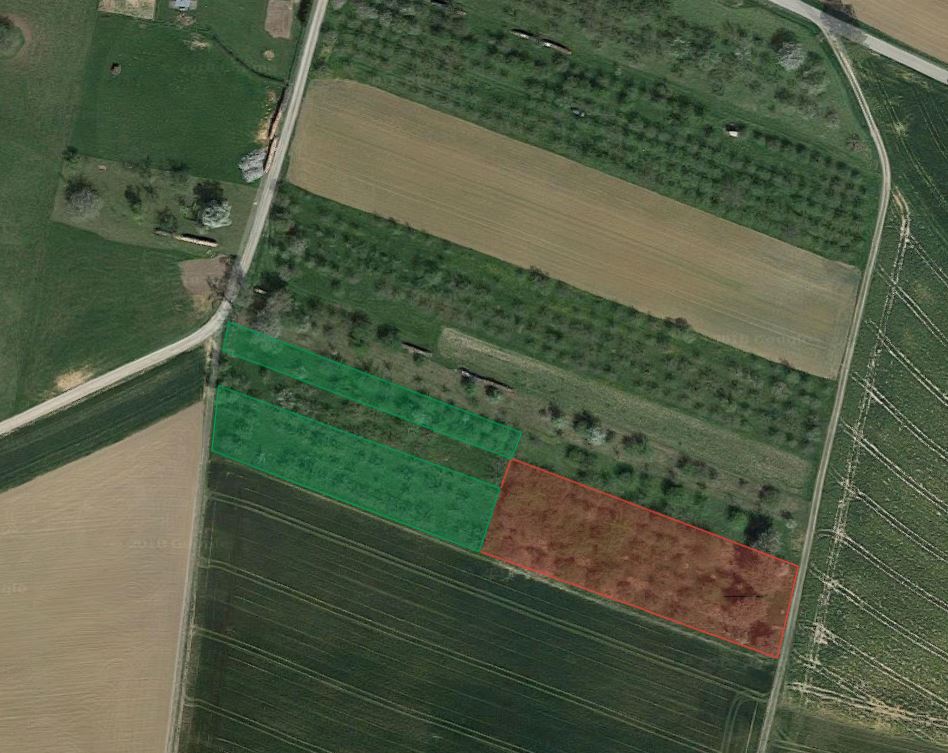
The man selling it got my number from my friend, and called me to ask if I was interested, and I told him we'd think about it over the weekend. Which I did, to a rather extreme level. My poor wife was sick of me running through scenarios, and pointed out that we wouldn't have to do anything if we owned it. There's no commercial pressure, just a hobby, and to be honest, part of the appeal was to try and preserve this as an orchard, as it borders onto tillage, and other sections of the overall orchard have been felled and sown with crops instead (see the treeless strips in the aerial image below).

So, the decision was made. We agreed a fair price, and today the legal contracts were signed, so we are now formally the owners. This now doubles our overall orchard size to over 6000 square metres (1.5 acres), which is rather daunting as a hobby!

Green areas are what we've owned till now. Today we added the red area.
The orchard itself has six rows of threes, four of which are continuations of one of our existing plots. The varieties of trees are pretty must the same, as they were all planted at the same time, in 1958. Varieties that were popular then, like Glockenapfel, Boskoop, Jonathan, Jonagold, Goldparmäne, Brettacher, Cox's Orange Pippin, and several others that I have not yet identified, but which are really interesting in terms of flavour profile.

Originally, the ends of every row had cherry trees, which our current plot is missing, so we will gain, I think, 5 very large cherry trees. Inside the cherry trees, each row then had a few pear trees, and this is repeated a thee ends of the rows we are purchasing. Mostly they seem to be conference, mirroring the ends of the current rows, but there are a few other varieties, like Bürgermeisterbirne/Köstliche aus Charneux, and I hope some perry pear trees and more Williams Christ.


We will have our work cut out, and probably need to take some drastic measure to open the plot up, for the sake of the trees. Personally, I'd also like to get in a full row of classic English and French cider apples, but let's see how it all develops. I'm probably nuts...


Sunday, 4 November 2018

Apple Harvest and Cider 2018

2018 was a strange year for our apples. The spring started warm and dry, and like all across Europe, the summer was a scorcher, and very dry indeed, shortening the season on many crops. "Notreif", or emergency ripe, one of my farmer friends said. And apples were of course affected. Varieties that we would normally be harvesting in mid-October were dropping en masse from early September, and the quality of the drops was not great, presumably a reason the trees decided to shed them so early. Nevertheless, it was indeed a bumper year for fruit, with most trees straining under the weight of the apples.

This was also the first year harvesting from the second orchard plot we purchased around this time last year. With about three times the amount of trees we had before, we didn't really have to care about the early drops, most of which we ended up discarding, as they would not keep. But we had plenty that we properly harvested using the tried and tested tarp-and-shake method.


This year we pressed over several weekends, including pressing for friends and neighbours. In total, I think we pressed about 2.5 tonnes of fruit, using the same mill and presses as last year. This time, however, as we had a greater choice in varieties to choose from, we also pressed some single varieties, to get a feel for them. If they work alone, fine, if not, I'll either bland them or get them distilled.


As well as our apples, this year I was also offered quince by a local chap. I expected a few sackloads, but it ended up being just over 300kg, which we pressed yesterday. Quince schnapps is quite popular here, so i reckoned that's what we'd do with them. But the juice is really tasty, with a decent acidity, a slight bitterness, and lots of sugars and perfumy, fowery flavours. If it still tastes good after fermenting, I'll set some aside for ageing as a kind of quince wine.


It's a difficult fruit to process, being rather hard and quite dry. But with a fine milling, the juice is released, though from about 280kg of fruit, we got 120 litres of juice, so about 42% efficiency. Other methods might be to use a steam juicer, but we couldn't have done that in any great quantity, but we might experiment with a 5 litre batch to compare.

For ourselves, we currently have the following in fermenters:

  • 60L Gloster
  • 60L Goldparmäne (King of the Pippins or Reine de Reinettes)
  • 60L Jonagold
  • 60L Conference pears (actually to be distilled, but if it tastes nice, may keep it)
  • 160L blend of several varieties, that has since been transferred to an oak barrel.
  • 240L mixed varieties that is destined to be distilled in the next couple of months.
  • 120L quince (also pressed for distilling, but the juice tastes so good, I may keep 60l as a wine/"quince cider", or for blending.


Pressing is not finished quite yet, as we have apples in storage (tumping, I learned is the correct term) that will be pressed for a keeved batch next weekend. Last year i made 50 litres of keeved cier as an experiment, and while i didn't think I got a full keeve, it fermented long and slow in our coldest cellar, and stopped with a final gravity of 1.012, so still has quite a nice sweetness to it. I'll report more fully on this year's batch, which i will increase to 120 litres.


So quite a busy and early harvest and pressing season this year, which has further distracted me from finishing the attic conversion, but I'll try to get back to that in the coming weeks, so I can start the tree pruning with a good conscience. Speaking of which, the orchard will expand again later this year, doubling our plot to 6000 square metres (about 1.5 acres). But that'll be a post in its own right!


Tuesday, 7 November 2017

New orchard plans

A few weeks ago, a lady popped by the house to ask if we were interested in buying a piece of orchard, just a 10 metres from the plot we bought in 2014. Four rows of trees that I'd been admiring, as they were well kept, and many labelled with the variety. Two rows had been in her family for many years, and the other two they purchased a few years ago. It was with heavy heart they decided to sell, but felt it was too much work as they had other projects to look after, something I could understand!


We had to chew it over, but decided we'd go for it, if for nothing else, to ensure that the apple trees stayed as they are, and not be felled and the ground incorporated into the adjoining tillage. We've agreed a fair price and are currently waiting for the legal parts to make it official.

On our current plot, we have the following apple varieties:
  • Goldparmäne (Reine des reinettes / King of the Pippens)
  • Cox Orange
  • Belle de Boskoop (both the normal and red mutation)
  • Klarapfel (White Transparent)
  • Glockenapfel
  • Jonathan
  • A couple others we do not know yet.

The new plot has all of the above, other than Jonathan, plus the following, that we know of:
  • Neckartaler (possibly also called Rheinischer Winterrambur)
  • Brettacher
  • Rubinette (one of the few "modern" varieties there)
  • Plus others unknown right now


The new plot has 54 trees (apple and pear), and our existing plot 30, with gaps across the two plots that leave generous space for another 20 new trees, which we will purchase for planting early in 2018. We've been researching German heritage apple varieties, of which there are a great many types, but also trying to make selections that would also be good for cider, in the Irish or British sense, rather than German.

So far, our list includes the following:
  • Börtlinger Weinapfel
  • Gravensteiner
  • Hauxapfel
  • Öhringer Blutstreifling
  • Rheinischer Bohnapfel
  • Schöner von Nordhausen
  • Zuccalmaglios Renette
We'll be adding some pear, cherry and plum trees to that list also, as the cherry plums behind our house are very old, and we'd like to ensure a supply in years to come.

I'd like to order some classic British cider apples from the UK. It's difficult to find suppliers that will ship to Germany, despite getting tips via Twitter from those in the know, and it seems that Orange Pippin Fruit Trees is one of the few that easily ship to mainland Europe, albeit with a limited selection of true cider apple varieties. So far, I think I'd like to order the following as half-standards:
  • Dabinett
  • Harry Master's Jersey
  • Ashmead's Kernel (as it sounds tasty)
Let's see where we end up.

Thursday, 15 October 2015

Harvest 2015 and first steps for cider

Over the past few weeks, we gathered up fallen apples, cleared away rotten fruit, and then had two days harvesting everything that was tree ripe. We've left the Boskoop and the Glockenapfel for a little later, as well as one Jonathan tree.

Actually, I had to harvest mostly alone, so used a trick a neighbour mentioned, to save my back some strain, by putting down a plastic sheet before shaking the branches, so I could gather the apples into a pile, and sort them in comfort.


In the end, we had 285kg of apples (including one box of really nice Köstliche aus Charneux (Legipont?) pears. The rest of the pears we gave away for a good cause.


On Monday this week, we then took the fruit to local Safterei Klein, which are a professional outfit with a band press, pasteuriser and packaging equipment.


We basically dumped the apples into a hopper where they were rinsed and fed into a mill, which then deposited the pomace onto the band, where it was pressed to crazy efficiency. The waste is then conveyed away, and is either composted or given away as feed.


Meanwhile, the hose was turned on and I filled six sanitised fermenters to the brim. In total, 202 litres from the 285kg of apples. It took less than 15 minutes to do it all.


Once we got our juice home, it had to be redistributed a little, to give some head space, so my neighbour kindly gave me a 60 litre drum he no longer uses. Then a careful amount of potassium metabisulfite was added to each container and left for a bit over 24 hours.

On Tuesday night, i pitched the yeast. Given I had planned for cider yeast for five 25 litre containers of juice, I had to improvise and use beer yeast in the big one. And that's it! Fermentation has started, albeit slowly, as the cellar is currently 16,2°C, but from what I've read, a slow ferment isn't all that bad, and it's going to be some time before we're drinking it. I'll transfer the cider to thicker-walled plastic drums once the primary fermentation is done, probably in a few weeks, and then turn my attention back to beer brewing, so we have something else to drink while we wait for cider.


And if you're interested, here's a video of the press in action, from Klein himself.


Addendum: I forgot to add that the original gravity of the juice was 1.058, with a total acid content of 7g/L, expressed as tartric acid. So, for malic acid, I think that's 6.3g/L, which seems to be acceptable. Just so I don't forget! 


Friday, 25 September 2015

Introducing the orchard

Late last year, we bought a strip of orchard from our postman's mother. Exactly a kilometre from our door, the patch is just under 1.000 square metres with 30 trees. Twenty three apple, six pear and one cherry, the majority being quite mature, having been planted in 1958 by a club or association (Verein in local parlance). Essentially, this group bought two plots of land in different locations and a bunch of trees, planted them, and divvied the land into strips, so each person had their own plot. At our orchard, the total area measures something like 200 x 200 metres, with our patch measuring 100 x 10, with two rows of trees. Some people have 200 x 10 metres, or multiples thereof, and the main use is of course to make Apfelmost, which is essentially still cider.


We were given a list of what varieties were there, and most are what people would refer to as "Mostapfel", though with a bit of storage, some seem to be exceptional dessert apples, and lots are definitely good cookers.

This was the list the former owner gave us.
  • Boskoop - Belle de Boskoop
  • Klarapfel - White Transparent. A very early apple, and one of my wife's favourites
  • Glockenapfel - I couldn't find an English name for this, but it's essentially Bell Apple
  • Goldparmäne - King of the Pippins
  • Cox Orange - Cox's Orange Pippin
  • "Rote Apfel" - well, there are red apples there, but clearly she didn't know the variety
  • Birnen - at least three varieties of pear, some eaters, some definitely Mostbirnen for making perry
I took the trouble of pacing out the two rows, to map what is where, but there are quite a few blanks to fill in!


The trees had been left to their own devices for a while, so even my inexpert eye could see that some action was needed to get them back into shape. We were a bit slow out of the gates this past spring (well, February was the month we moved in), and it was mid-March by the time we went up with ladders, saws and loppers, to do some damage. We probably need more practice, but we at least got some of the worst conditions sorted a bit, though at the time, with no leaves on the trees, we were not always sure what kind of tree we were looking at.

Following this, we basically ignored, or rather forgot the orchard for a while. We walked though it while the trees were flowering, which was a lovely sight, but it was only a few weeks ago that we went back up for a look at how the apples themselves were doing. This was rather stupid, as the Klarapfel are an early variety, and we totally missed them. At least we know for next year.

We had allowed a neighbour to graze his sheep under the trees, which was one reason why little needed to be done during the year, as the grass was kept down. However, in future I'll ask him to keep them out after July so there is no shit on the ground during harvest time. We also learned that they like to half-chew apples when, a week ago, we went up and picked up all the fallen fruit. This yielded about 34kg of unchewed, non-rotten apples that can be used. We dumped probably six or eight times that much, between fruit that had simply rotted and many half eaten by the sheep. What we rescued were then washed and are now stored in trays in the cellar.

Boskoop on the right.
We were up again yesterday evening and got another 30+kg, with a far smaller proportion of rotten fruit, that had fallen during a windy day earlier in the week. We intend to harvest the rest in a week or so.

Even with the fruit on, we're uncertain what is Cox's Orange and what is King of the Pippins, so we're going to ask an expert to take a look, and my orchard map will be complete.

But what will we do with all this fruit? For those who know me, the answer should be obvious, but the main intention is to make cider, as well as having our own apple juice. Both are very popular around here, though the cider I intend making will be sparkling, unlike the flat Apfelmost that the older generation make in this village (which is really good!).

I'm very excited about making cider from our own apples, and have been reading some good books on the subject. But given my lack of experience, I don't know how ideal the mix of apples we have is for a good cider. However, these trees were most likely planted exactly for such use, so I'll just wing it this year and see how it goes. We have space for more trees, so as I learn, perhaps a few more varieties will be added to alter the blend a bit.

There's still much to before we get that far, but I'll post an update following the harvest and pressing. For now, here are some gratuitous shots of the apples waiting for harvest. If you recognise any, let me know!