Monday, 4 July 2011

Like pulling teeth...

Location of cellar 4.
...literally! You'll see why below.

There haven't been many blog posts on progress of our own work, but that doesn't mean to say we've been doing nothing. It's just slow, dirty work, and the place is a mess. But then that's part of the fun, so there will follow a few "in progress" posts, despite the piles of plasterboard lying around the place (we need a container soon).

Cellar 4, before work began, June 2011.
The first rounds of estimates are in, and we're finalising details to select contractors. First off will be the Mauerer (equates to a bricklayer, but I think of it more like a general builder) who will demolish the 1970s bathroom, dispose of the asbestos roof, knock through walls, build new walls, sort out drainage and, one of the bigger jobs, re-lay the floor in cellar 4, as this is where the boiler and pellet storage is currently planned.

The floor of this cellar is a patchwork of cobbles, concrete tiles and poured concrete. All of that has to come out to a safe depth (foundations are probably quite shallow) and layers of gravel, membranes and concrete laid to reduce the capillary action that is currently making this quite a damp room. When it's raining, the borders between these patches of different floor look damp, so much so, that we wondered how high the ground water might be, considering the house is built into a slope.

Stratigraphy!
First job was to dig a test pit, about 60cm deep, after which it was ignored for a week to see if water would seep in. I was surprised it didn't, but then, there is quite solid clay, above which was a 12cm loose course of sand and lime followed by fairly deep limestone cobbles. There's definitely lots of moisture, but just not of the running water kind. If a cobble splits, it's shiny and moist inside, so definitely rising water issues to solve.

We want to keep the cobbles for further use, and that's monkey work I can do rather than paying someone to do it (every little helps), so this has been one of my tasks over the past couple of days (and after a week in Edinburgh, just what the Doctor ordered). Mostly, this has involved work with a lump hammer and masonry chisel to loosen the stone, then just lift. Not too heavy until two-thirds across the area where they are sitting, bonded in what looks like limecrete (I assume so if this goes back some time). This really is like pulling teeth, having to bash a gap between stones in order to then prise it out with a crowbar, leaving a socket behind. I had thoughts of lifting and re-laying the floor in cellar 1, which is completely cobbled, but that's now on the very long finger.

The stones are being stored in one of the cellars in the barn, which we now refer to as the Stone Room. All manner of reclaimed bricks, tiles and other stoney material are being stashed here for better times.

Part of the cobbled are remaining in cellar 4.


About a quarter done, with the easy stuff.

Where it starts getting hard. Literally.

There's been decades of cow and horse urine over these stones, but no treasure found under them yet!

Friday, 24 June 2011

A House of Two Sides

We've known for quite a while that the house was originally split in two halves, each with it's own stairwell (loads of evidence for that!), and presumably entrance door (the two centre ones, obviously). What we don't know, is when it became one, with the stairs on the right hall removed and doors opened between the halves. It was still separated in 1937, according to the plans we have from then. We've theorised about whether it may have been built in two stages, as the fachwerk, the timber construction on the facade, shows differences in style between left and right. We thought perhaps the left might be a little older, but  last Saturday morning, while talking with a expert restorer (Thanks Franz Geiger!), a bunch of clues that we'd alreeady noticed clicked into place.

The facade on the right has diagonal cross-bracing, the facade on the left has horizontal bracing. We were told that the facades are usually symmetrical, so if you look at the facade from the right edge, the diagonal braces go down, up, down, up, down... no up to the left of the window above the former entrance door. It's like something is missing.

The left facade, June 2011. Note horizontal cross-bracing.
The right facade, June 2011. Note diagonal cross-bracing.
One of the more subtle clues is the fact that the upright timbers on the right of the facade have carpenters marks on them, following a numbering system that has been used since the medieval period. The uprights on the left have none. Moving from right to left, the uprights are numbered in descending order, We have ... XIII, XII but no XI as expected left of that same window.
Hard to see, but the central post is XII, the one to the right can be seen as XIII. Note also the different thickness.

The photo above shows that the base beam on the right is thicker than that on the left (not so conducive with one building phase where they might have taken care, or perhaps even tried to use one single beam).

Measuring between the edge of the door frame and the inner wall surface on each side of the dividing wall, and taking into account the usual symmetry in such facades, the distance from the edge of the right door to the dividing wall tallies with what one might expect given the spacing of the timbers on the far right of the facade. There's a bigger distance on the left side which suggests that it's not "in harmony".

Right corner, and new upper wall from 1937.
The corners of each side have differences. The gables on each side are currently masonry, however on the left it has sandstone blocks on the edge while on the right is a large oak post. On this side, there's an oak beam running as a footing under the brickwork. Another clue here is that on the 1937 plans for works, the gable on the right is marked as red, meaning it was new (well, it replaced something that was already there). We now suspect the entire right gable was originally half timbered and one level of this, and the rear wall, was replaced with masonry in 1937. In fact, these walls are made of red bricks, not stone like the rest of the outer and lower walls.

To cut a long story short, we think the right side of the building is older than the left. We think there was a smaller building here, with upper levels entirely half-timbered, and some time in the past the left side was added on, with a stone gable, and that at this time the entire roof was replaced to make a single roof structure. The room layout is almost perfectly symmetrical on each side, but it is odd that no such attempt was made to make the facade symmetrical.

This is all based on clues above, but we'll need an expert opinion, and maybe some dendrochronology to get some harder facts. We'll also do a little more documentary research to see if we can get some earlier maps. It just occurred to me that I found some charcoal while digging a test pit in the stalls on the right of the house (it's damp there, and I was trying to see if the groundwater was a bit high), and this could be carbon dated. If I could find some on the other side...

This is what happens when you have an archaeologist (my wife) and someone who worked in archaeology for almost 8 years (me, but I never called myself an archaeologist). Old habits die hard. Still only a theory though!

Since then, Franz gave us contact details for an expert on putting together the historical story of such houses, so looks like we'll have a better idea later this year.

Thursday, 23 June 2011

Half-Life 1950

We've a few old tools lying about, some of which are very odd-looking to a city boy like myself. One looked so much more like a lethal weapon than a farm implement, it put me in mind of Half-Life, and wondering what it might look like if set in an early 20th Century German farm. Bear with me for this intermission :)

The classic, and my tool of choice for the last few months. Something to set the tone. If in doubt, crowbar it.


This was hiding at the back of the barn. Might need a little sharpening, but the weight alone would carry it through alien scum (or the Marder).


An upgrade to a two-pronged hay fork would give better reach, but you'd need to be accurate.


Four have to be better than two! Skewer those headcrabs! Or muck out horse shit.

We have about five of these. Lots of prongs, but with rounded tips. Great for digging out beets (it's a Sechszinkige Rübengabel), but not sure how confident I'd be heading into that unlit cellar armed only with this.


This looks like some sort of vorpal weapon. You'd expect lightning to be shooting from it at least, but it's a Zweizinkiger Rübenheber, for digging out beets. It's heavy! They don't make them like they used to!

To be honest, this has to be one of the top tools in the armoury. That blade would actually bend pretty quickly, but really, if Death uses this as a tool of choice, surely that counts as something?

Thursday, 16 June 2011

In the Shadow of the Church

Just over two weeks ago, we moved from the highest point of the village, with houses built in the last 15 years, to the lowest, with houses, like our own, considerably older than that. It's like it's become some sort of hobby, but we're now living in a house right next door to The Bauernhaus itself. This is really handy, as we can pop over to tend the veggies, do a bit of work, and when things start going, keep an eye on the work. On the other side (south) is the Evangelisch church dating from 1473. So we are now, literally, in the shadow of the church.

Centre of Mittelschefflenz, pre 1960.
The house we're living in now was built in 1900, with a recent extension replacing the site of an older barn. The house can be seen to the left of the church in the photo to the right. I'm not sure when this photo was taken, but it's pre-1960, as it predates the town hall that was built more or less in the foreground. Where the person in kneeling, by a water trough in the centre, is where the stream, the Kertel, ran until it was culverted (thankfully, it still runs open on the south side of our land, and is really handy for hauling water from for the garden in dry weather). The half-timbered house on the right of this photo was demolished only a couple of years ago to make way for the new town hall, despite originally being a protected building. Our house is out of frame, about 40 metres to the left, but this old photo gives an idea of how open that area was in the past.

View from the Hof of number 2
This house, number 2, is also a former Bauernhaus, clearly, and there's a nice little courtyard at the back with several half-timbered and stone outbuildings and barns. A nice place to sit in the sun, but the configuration greatly amplifies the sound of the church bells. We get a ding-dong for every quarter hour, and deeper bongs ringing the hours. All night. Twelve bells was never so real! After two weeks here, we almost don't hear it any more. But at certain times, 11:00 and 19:30, it goes mad (movie below, with low resolution due to ultra-slow Internet connection, but it's the sound that counts in this case).


 In terms of progress on The Bauernhaus, I was a little premature with celebrating our planning permission, as it's only since yesterday that some of the final points were finally closed before we get the "red dot" that is the go signal. We had to meet the local Fire Commandant to look at the size and positioning of planned roof windows for the purposes of escape routes. All clear now!

In the meantime, our architect has been putting out incredibly detailed work lists, and the first set of offers from general builders have come in. A little bit shocking, and quite a range in price, but the detailed costs breakdown the architect specified is making it easy to compare. With luck, the first heavy works can begin in mid-July, just over two months later than originally planned.

Still, we're now at the heart of the village, and it's much nicer down here, with the company of the resident pine marten..

Wednesday, 4 May 2011

Milestone: Planning Permission Through

Three months and a few days after submitting our planning application, we finally received the ok (with conditions) today. It should have only taken six weeks, but with additional requirements regarding fire protection (because the barn is so close to the house, and always has been!), easement requirements and poor communication, it seemed to just drag out.

Planned front elevation.
Nevertheless, it's done, and we're officially able to begin the major works. Almost. Our architects need to finalise detailed plans for the works, and we're considering how to best find contractors. We'd prefer to keep as local as possible for all sorts of reasons.

This also means we can reveal a peek at what is planned. Already seen on the first post of this blog, the south, or front facade, will remain more or less as is. We do of course need new windows and doors of a type approved by the protection agency (meaning wood frames, with multiple panes in keeping with the period of the house). We plan on inserting four new dormer windows (Schleppgauben in this case) to bring more light into the second floor (first attic level).

The back of the house, Feb 2011.
The rear has some major changes planned, with the 70s bathroom extension being knocked down (itself subject to conditions, as the roof is asbestos, as are the cladding tiles) and being replaced with a nice new door leading directly from the kitchen into the garden. Above the kitchen, will be a new gable dormer, where the new bathroom should end up. This might be a little tricky, as it potentiallly means shifting a supporting beam to make more headroom, but it's either that or have a face-level oak beam running across the middle of the bathroom. Could be a nice feature!

Several roof windows will be inserted to bring light into the top levels of the attic rooms. Normally such windows are not allowed in protected buildings, but as it is the rear of the house, and we're not planning major remodelling of the interior, our request was accepted (considerably cheaper than building more dormer windows).
Planned rear elevation.
While the front of the house will have wall insulation on the inside, due to it being half-timbered, the rear and the east gable will be insulated externally. The east gable faces the barn, and there aren't so many windows here, with two old windows on the 1st floor having been blocked up in the past (not much of a view looking out on a barn wall). All the windows shown in the elevation below are original, with the red-marked one currently being hidden behind corrugated iron cladding. In fact, there's another one also hidden not shown on this, and that will also be opened up. This elevation also illustrates the change at the rear of the house, with the current extension shown in yellow, and the new dormer gable (not sure if that is the correct technical term) shown in red outline.
Planned east gable.
The west gable is also pretty much as is. Lots of windows here. This will be insulated from the inside. As we are not allowed put the normal German roller shutters on the windows, we plan on eventually having more traditional wooden shutters, at least on this gable. The hinges are still there from the old ones.
Planned west gable.
So, time for a minor celebration, and really getting down to work!

Saturday, 30 April 2011

Naked walls in the living room.

Things have been going very slow on the house. Much slower than planned, mainly because we are still waiting on the planning application, which we expected to be through at the end of March. It's basically through, just waiting on some formalities and paperwork, so we're in the process of finalising working plans to get quotes.

In the meantime, I've been doing more clearance work in the living room, slaughter room (I really should start calling it the kitchen now) and one of the bedrooms on the first floor.

In the last post, I showed the first steps in the living room, removing the partition wall and revealing the oak beam which was cracked. Since then, an engineer paid us a visit (well, we'll be paying him) and said it could either be replaced with a steel beam, or can be left in situ, though a post would have to remain to support it. I'm assuming replacing it with a steel beam with be costly, although we won't know for sure how it might be done until I take down the ceiling.

Dry lining removal continued over last week (I had an enforced break from heavy work after falling and bruising my spine a few weeks ago, which also delayed our own works), so the walls in the living room are now plasterboard-free. You can do a before and after using the first living room post.

Living room, April 2011.
In the room to the rear, I was surprised to find bare stone walls behind the plasterboard. In all other areas there was still old plaster with layer upon layer of old paint, often with wonderful stencilled patterns still remaining. There are still traces of clay-based plaster between the stones, so presumably plaster was removed before sticking the Styrofoam-insulated plasterboard onto the walls. More on that below.

I like the idea of leaving one of these walls exposed, cleaning it up and re-pointing the stones. The back wall will be insulated from the outside, but unfortunately the west wall (left in the photo to the right) will be insulated from the inside.

The opposite wall was clearly scoured before the plasterboard was "glued" to the wall with blobs of plaster. Several layers of paint and thin plaster have been exposed, with some of the earliest showing as turquoise, with brown, geometric flowers stencilled on. The brighter patch on the right, as seen in the photo to the left, is not wallpaper, it's actually a white or cream base with a stencilled pattern. At the top left, the underlying bricks are exposed, which don't exactly look ancient. This part of the wall is thinner in plan (see the floor plan at the top of this post), and it is possible that there was formerly a door here that was later bricked up.

Section of the fuchsia pattern.
In the southern part of the overall living room (the large room before the partition was taken down), there was no plasterboard, so once the wallpaper was removed, the old paints were exposed. There are six or more layers, probably, thogh only the most recent can be seen to any great extent, the rest are only exposed in small, enticing sections. As it happens, I think the latest one was very pretty and delicate, being a stencil of what looks like fuchsia in five colours. This was rendered in repeating patterns, spaced about 80cm apart, with geometric patterns of circles of radiating lozenges and wavy lines between.
The fuchsia stencil.
Next step in this room, take down the plasterboard ceilings to make sure there are no surprises hidden above.

Sunday, 3 April 2011

First steps with a crowbar.

The living room.
We're still waiting on the planning permission to come through, about two or three weeks longer than expected, but we know it's now just waiting on one document to be signed by the neighbours. It's time to get things moving, and get more detailed plans for specific works ready, and start getting quotes.


In the meantime, we've been getting the vegetable garden out back into shape, and over the weekend I began taking out the thin wall that has been dividing the two rooms on the west side of the 1st floor.
A reminder: the living room, January 2011, taken from the southeast corner.
Use of hammer and crowbar to reveal innards.
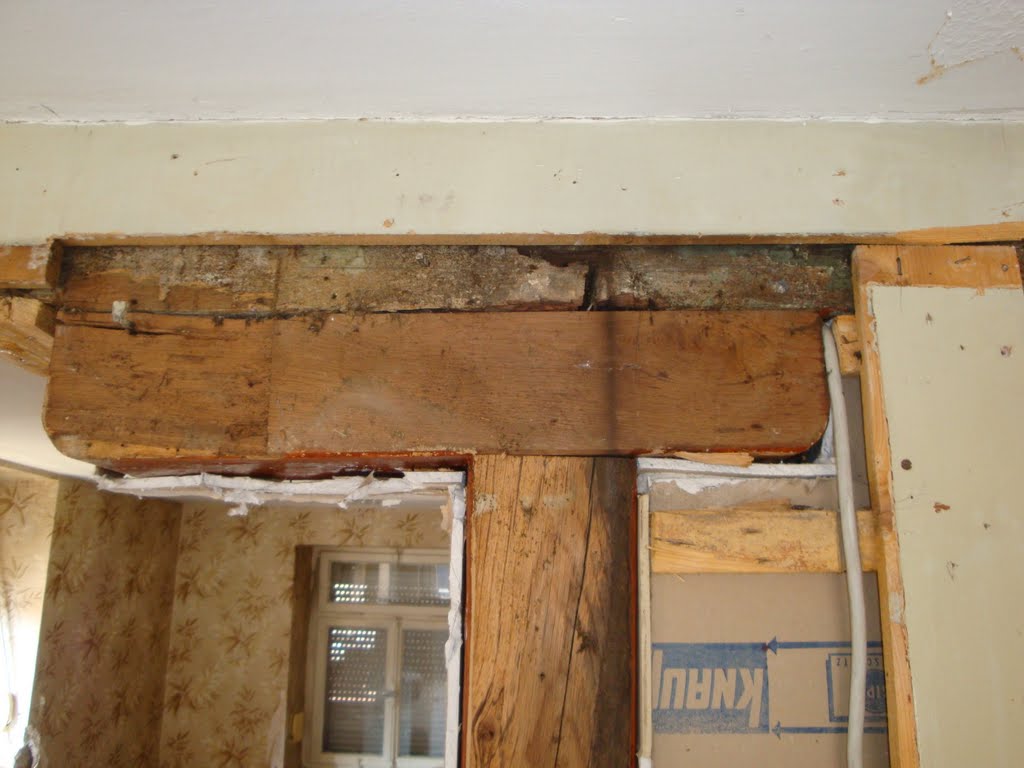
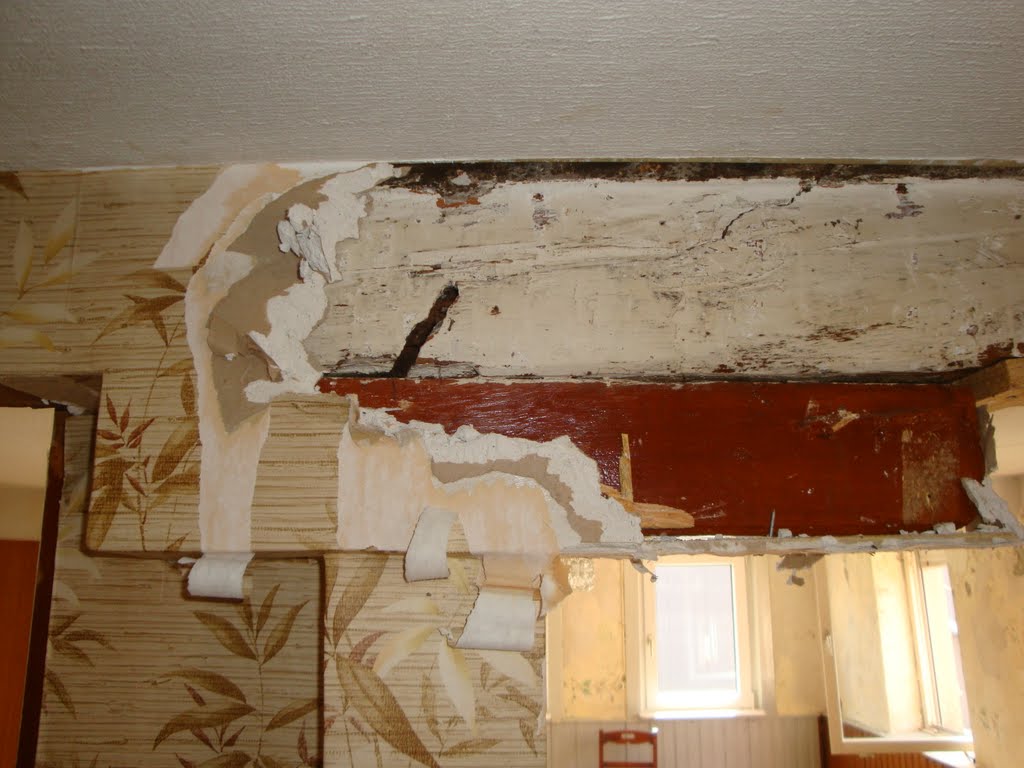
We knew this wall was "new", all things being relative. It was about 5cm thick, and on the north face of it, there was clearly a large post within the wall, supporting a beam running across the room. After taking wallpaper off, it was confirmed to be plasterboard, put up on the 8th of June, 1998 (the date was written on it!). On Saturday, I took the plasterboard down from the south-facing side I expected to see a partition frame and the back of the plasterboard on the other side, but was faced instead with paneling, that looked like it had been salvaged from elsewhere. The most exciting part of this was exposing the beam, which can be seen on the top-right of the photo to the right. It's seriously bowed, hence lots of spacers to level off the plasterboard it was covered by, but the painted decoration was nice to find, so looking forward to exposing the whole length.

Painted decoration on previously hidden beam.
Wall mostly gone, bow in beam clearly visible.
 Once the paneling and other side of the wall were down, it was clear that a more substantial wall had previously been here, There are mortice holes in the under-surface of the beam, but I can't explain why more substantial oak beams were removed and replaced by a relatively flimsy partition. Or can I?
We assumed the post that we knew was in the middle of the span was there as part of the wall, as the span is relatively short, and there are longer spans unsupported, even in the same room. However, it became clear that it was supporting the beam, which is heavily bowed (and not unusual for such buildings). However, it also became clear that the beam has a rather large crack, so this support is essential.
 
First clue about cracked beam.
This beam is anchored to the gable end of the house, and the other end into a supporting internal wall. It seems that the lower part of the gable wall settled some time in the past (one assumption is when modern drainage was run alongside the house, possibly causing the foundations to shift a bit), forcing the gable to tilt. This caused a gap that can be seen in the ceiling in the cellar, but clearly also put this beam under considerably more tension that it could deal with, so it snapped. It's worrying, insofar as a part of the house has moved, but it would seem that this movement was in the last 40 years (and none apparent after June 8, 1998!). At least the architect (for whom I have great respect) said not to worry!
Crack confirmed on the other side.
As it happens, we will meet with a structural engineer this coming week to talk about what walls can be broken through. This beam, and the crack in west gable are now going high on the list of things to talk about.

I like the crowbar. I even had my Gordon Freeman work glasses on while wielding it!